Looking for more resources on oral health?

FDI World Dental Federation serves as the principal representative body for more than one million dentists worldwide, developing health policy and continuing education programmes
Filter by topics
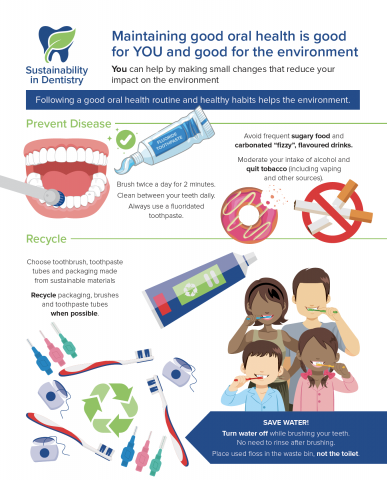
Maintaining Good Oral Health
Maintaining Good Oral Health Infographic
Infographic
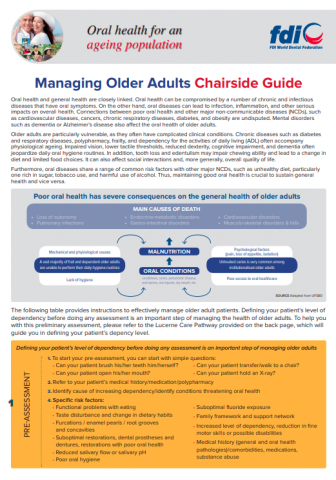
Managing older adults_Chairside guide
Oral health for an ageing population
Managing older adults: Chairside guide
Chairside guide

This chairside guide provides recommendations based on the Lucerne Care Pathway to support targeted service-delivery strategies that avoid under- and over-treatment and foster a life-course approach to oral health.

Mental Health Toolkit for Dental Students - FDI
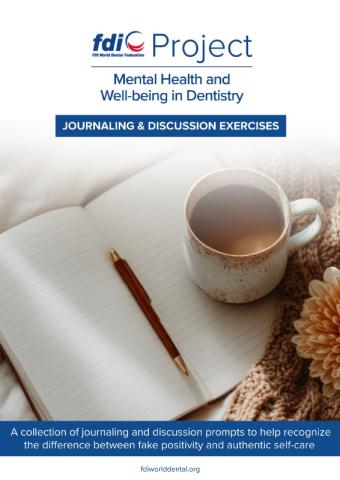
Mental Health and Well-being
Mental Health Toolkit for Dental Students
Toolkit

This toolkit is a practical guide that helps dental students recognize and respond to common mental-health challenges (stress, burnout, imposter syndrome, hierarchical pressure, cultural isolation, and lack of peer connection) and includes short self-assessment exercises, practical coping steps, and signposted external resources.

Mindfulness Exercises - Mental Health in Dentistry - FDI
Mental Health and Well-being
Mindfulness Exercises
Fact sheet

This resources encourages the integration of simple, regular practices to reduce anxiety, foster calmness, and support mental health during training and work.

DECLARATION Mumbai
Vision 2030
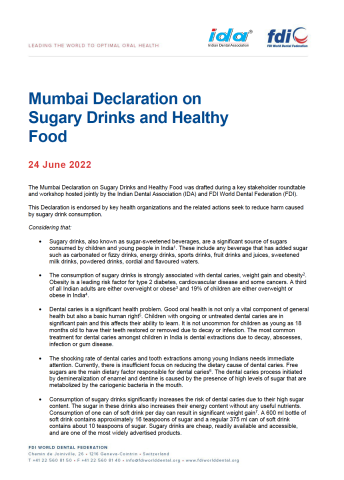
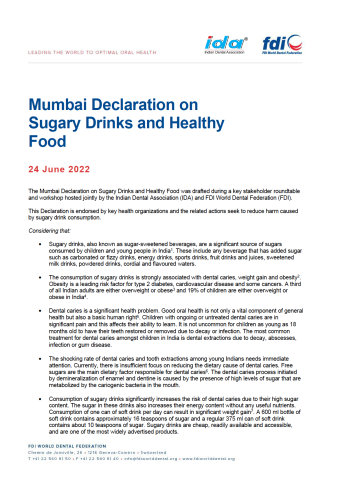
Mumbai Declaration on Sugary Drinks and Healthy Food
Declaration
Mumbai Declaration on Sugary Drinks and Healthy Food
Sugar
Mumbai Declaration on Sugary Drinks and Healthy Food
Declaration
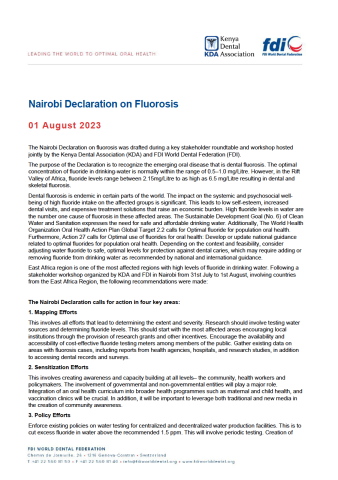
Nairobi Declaration on Fluorosis
Sugar
Nairobi Declaration on Fluorosis
Declaration
Civid 19 vaccination
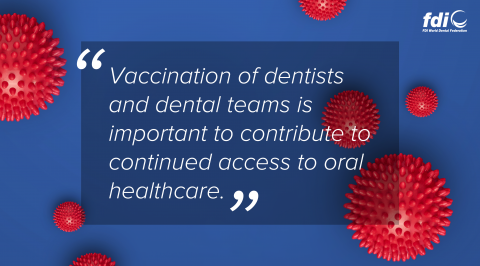
New FDI World Dental Federation global survey reveals that two-thirds of countries are not allowing dentists to administer COVID-19 vaccines
Press release

Survey also shows that half of the responding countries have agreed to include dentists in their priority vaccination groups.

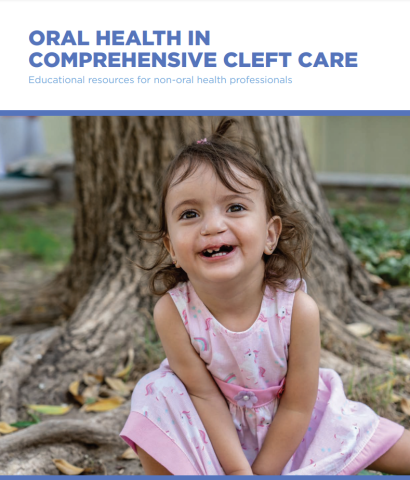
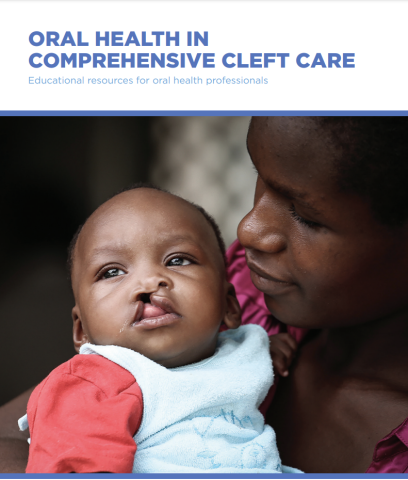
Oral health in CCC resources for NOHP cover
Cleft lip and/or palate
NEW Resources for Non-Oral Health Professionals
Toolkit
OH in CCC NEW Resources cover
Cleft lip and/or palate
NEW Resources for Oral Health Professionals
Toolkit
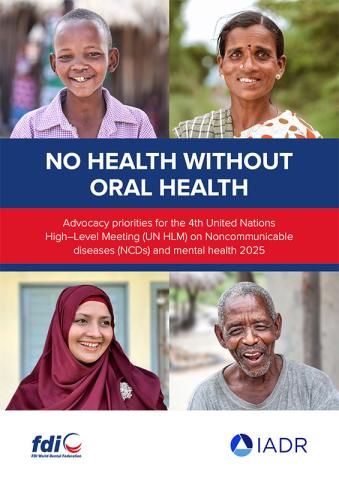
No Health without Oral Health
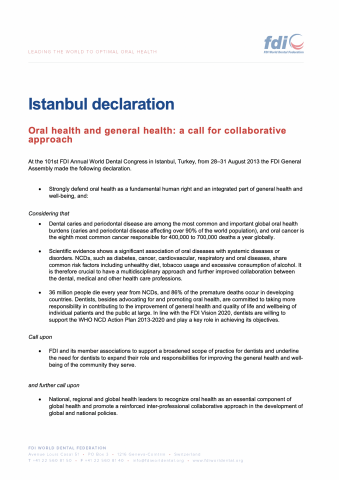
Oral health and general health
No Health without Oral Health

The fourth UN HLM on NCDs (HLM4) will take place on Thursday, 25 September 2025. FDI and IADR are mobilizing all stakeholders with interest in oral health ahead of HLM4 through coherent and aligned recommendations for governments. 

No health without oral health_proceedings
Oral health and general health
No health without oral health: How the dental community can leverage the NCD agenda to deliver on the 2030 Sustainable Development Goals
Proceedings

These proceedings are based on the FDI-NCD Alliance joint session that took place during the FDI World Dental Congress in Madrid, Spain on 30 August 2017. The session focused on leveraging the NCD movement to advance oral health, with a particular focus on the United Nations Sustainable Development Goals.

NOHP Trainers manual
Cleft lip and/or palate
NOHP Trainers manual
Toolkit
Optimal Oral Health through Inter-Professional Education and Collaborative Practice
Oral Adverse Drug Reactions Fact Sheet
Other Healthcare Professionals
Oral Adverse Drug Reactions
Fact sheet
Oral Adverse Drug Reactions
Other Healthcare Professionals
Oral Adverse Drug Reactions Infographic
Infographic
Oral cancer_Chairside Guide
Oral cancer
Oral cancer chairside guide
Chairside guide

This chairside guide advises oral health professionals on how to screen for the most common sites of oral cancer: tongue, insides of cheeks and floor of the mouth.

Oral cancer_Prevention and patient management_toolkit
Oral cancer
Oral cancer: Prevention and patient management
Toolkit

Oral cancer is a type of head and neck cancer and is any cancerous tissue growth located in the oral cavity. This guide focuses on oral cancer, which dentists can detect by observing the oral mucosa, as it is both superficial and accessible.